
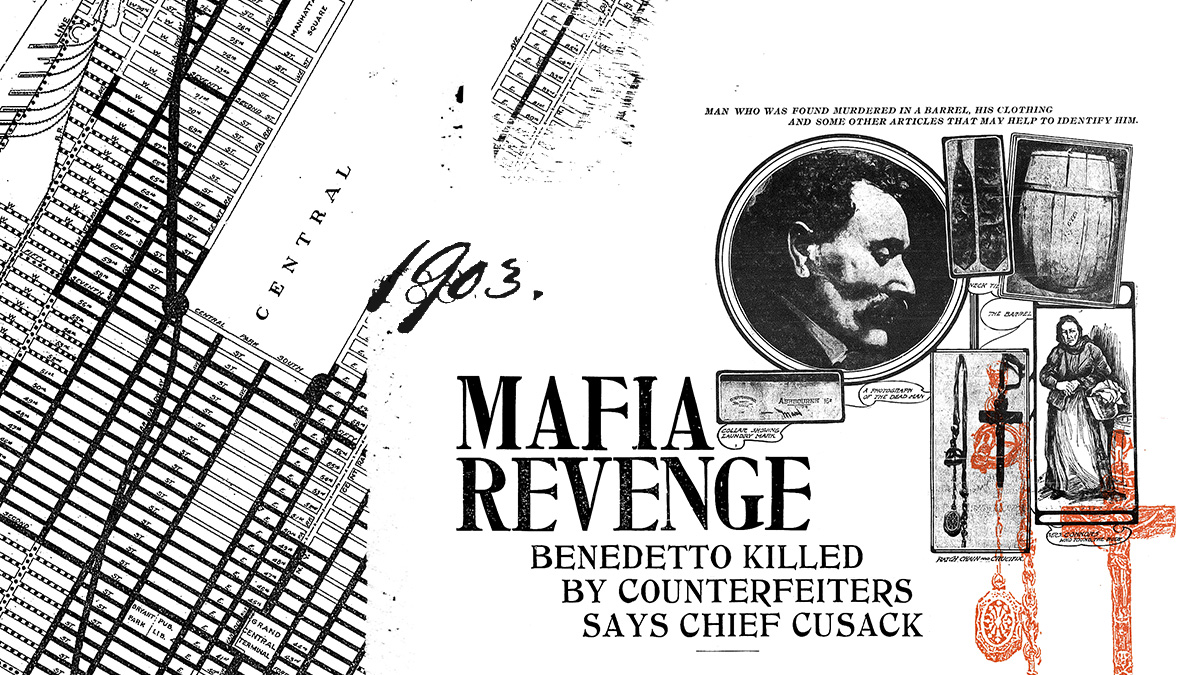
The Barrel Murder

1903. The dis­cov­ery of a body stuffed in to a bar­rel brings the secret ser­vice down upon the Morello gang.

Petto the Ox

At 5.30 am on Tues­day 14th April 1903, in front of the build­ing at 743 East 11th Street at Avenue D, a bar­rel was found with a man’s body inside. The throat was cut from ear to ear, and the head almost sev­ered from the body with eigh­teen stab wounds in the neck. The body had been forcibly pushed into the bar­rel with the head rest­ing between the knees. He was thought to be in fairly pros­per­ous cir­cum­stances, due to his clean per­son, good clothes and newly man­i­cured nails. In his pocket was a piece of paper, upon which was writ­ten “Come at Once!” in Italian.

The police believed the bar­rel, that had once been used for ship­ping sugar, was dumped from the back of wagon in the early hours. On the base of the bar­rel was sten­ciled “W.T” and on the side “G 228″. The coro­ner con­cluded that stab wounds to the neck were inflicted before the killing cut to the jugu­lar vein, this meant he was either attacked in his sleep or restrained as he was tortured.

The fol­low­ing day three secret ser­vice agents, who had been track­ing the Morello gang for over a year under a coun­ter­feit­ing inves­ti­ga­tion that cov­ered New Orleans, Buf­falo, Pitts­burgh and Chicago, claimed to have seen the vic­tim with var­i­ous mem­bers of the gang through out the day, and finally in a butcher’s shop in Stan­ton Street with mem­bers of the Morello gang on the evening of Mon­day 13th.

The arrests

So at 8.15pm on Wednes­day 15th, as eight mem­bers of the gang were walk­ing down the Bow­ery, they were arrested. It was thought that the men were walk­ing together on their way to an evening meet­ing. The police had been watch­ing all the gangs known ren­dezvous points : the Stan­ton Street butcher shop, a café at 226 Eliz­a­beth Street and a saloon at 8 Prince Street , where Giuseppe Morello kept a restaurant.

Each mem­ber of the gang was found to armed, with either a knife or a pis­tol, Morello and Petto held firearm licenses for New York state. The names and addresses the men gave to the police were :

Giuseppe Morello — 226 Eliz­a­beth Street
Tom­maso Petto — 238 Eliz­a­beth Street
Joseph Fanaro — 25 Riv­ing­ton St
Anto­nio Messina Gen­ova — 514 East 15th Street
Lorenzo LoBido — 308 Mott Street
Vito LoBido– 308 Mott Street
Dominico Pec­o­raro — 189 Chrystie Street
Pietro Inz­er­illo — Prince Street

The gang

Only Vito Lad­uca was miss­ing, he was known to the secret ser­vice after a recent arrest in Pitts­burgh. The secret ser­vice stated that the Morello gang had been as large as thirty at one point, but recent con­vic­tions of coun­ter­feit­ing had trimmed the num­bers back. Some of the gang had been recently con­victed of coun­ter­feit­ing Mor­ris­town, NJ, five dol­lar notes. Other mem­bers had been arrested and con­victed in 1902 after a raid in Hack­en­sack, NJ.

The police located the premises where they thought the mur­der had been com­mit­ted. It was a pas­try shop on 226 Eliz­a­beth Street — Dol­ceria Pas­tic­ce­ria, run by Pietro Inz­er­illo, it was there they found an iden­ti­cal bar­rel to the one used in the mur­der, even bear­ing the same inscrip­tions. The saw­dust on the floor of the shop had also been found in the base of the mur­der bar­rel. Sim­i­lar shops cooked food in their base­ments, how­ever the pas­try shop base­ment had no facil­i­ties for cook­ing and only con­tained an empty bar­rel, and some burlap which was the same as that found in the mur­der bar­rel. The bar­rel was even­tu­ally traced to Wal­lace & Thomp­son bak­ery, where their books showed an entry of a sugar order by Pietro Inz­er­illo back in February.

Petrosino diary

More arrests

On Thurs­day 16th April, four more men were arrested in con­nec­tion with the mur­der. Ignazio Lupo, an importer of wines at 9 Prince St, was arrested at 433 West 40th Street, his apart­ment was forcibly entered whilst he was asleep. Feign­ing ill­ness, a physi­cian was called from the Roo­sevelt Hos­pi­tal to check him out, he was deemed fit and taken in to cus­tody. In his flat they found a dag­ger and three revolvers. The same morn­ing Vito Lad­uca was arrested along with Nicola Testa in a ten­e­ment oppo­site the Stan­ton Street butch­ers. Later at 9am, at Eliz­a­beth and Prince St, Giuseppe Lalamia was arrested by Lt. Pet­rosino as a rec­og­nized mem­ber of the gang.

That after­noon three patrol wag­ons car­ried the pris­on­ers to the Jef­fer­son Mar­ket Court to be arraigned. A large crowd had gath­ered out­side the police sta­tion, many thought to be Ital­ian sym­pa­thiz­ers. The police broke up the crowd after they feared the pris­on­ers may be freed or passed weapons. At the court they were held on the charge of “sus­pi­cion of homi­cide” and remanded to police cus­tody for forty eight hours. It was dis­cov­ered that Morello and Petto held gun per­mits granted by Deputy Com­mis­sioner Piper, under the autho­riza­tion of the local police captain.

Inspec­tor McClusky was quoted on April 16th:

Credit for the quick solu­tion of this mys­tery must be given to the splen­did sys­tem of sur­veil­lance kept up by the Secret Ser­vice oper­a­tives. After the mur­der of Joseph Cata­nia, in Brook­lyn, last sum­mer Chief Inspec­tor Flynn, of the East­ern Sec­tion of the Secret Ser­vice, learned that Cata­nia had been a mem­ber of the Mafia and was asso­ci­ated with a gang of coun­ter­feit­ers whom the Bureau had long had under surveillance.

On Fri­day 17th April the pris­on­ers were re-arraigned at Jef­fer­son Mar­ket Court. The men were again remanded to jail for 48 hours until Sun­day morn­ing. Attempts were still being made to iden­tify the mur­der vic­tim. One dis­patch that reached Inspec­tor McCluskey stated that the man was Anto­nio D’Andrea from Chicago, but the police there soon con­firmed he was in prison for pos­ses­sion of coun­ter­feit money. W. Hazen, the ex-chief of the secret ser­vice, iden­ti­fied Morello as an ex-convict, he claimed that Morello had been arrested in 1900 and con­victed of a coun­ter­feit­ing charge.

The home of Morello was raided at 178 Chrystie Street, the police found lit­er­a­ture in his loft that con­firmed their sus­pi­cions that he was the boss of the gang, and that he had directed the affairs of var­i­ous branches of the Mafia in many cities. Other paper work found at Lupo’s address proved his con­nec­tion with killing of Giuseppe Cata­nia in 1902. The butcher shop and the pas­try shop also con­tained paper evi­dence of a large black mail­ing scheme, in the same style as the Black Hand.

Whilst held in the Jef­fer­son Mar­ket Court, Lupo was con­fronted in his cell by the police. They ques­tioned him about a mur­der case he fled from in Sicily before arriv­ing in Amer­ica (Sal­va­tore Morello). They called his bluff and Lupo admit­ted to the mur­der. If they could not secure a con­vic­tion for the bar­rel mur­der against Lupo, the secret ser­vice planned to arrest him again on coun­ter­feit­ing charges whilst the police gath­ered more evi­dence against him for murder.

They also planned to pin another mur­der on Lupo based on evi­dence found dur­ing the raid on his flat. Lupo was the last man seen with Joseph Cata­nia, a Brook­lyn gro­cer who was killed. His body, sewn in to a sack, was found at Bay Ridge in July 1902. Joseph Cata­nia was believed to have been involved in coun­ter­feit­ing with the gang before his murder.

On Sun­day 19th April, the pris­on­ers were arraigned for a third time. ADA Gar­van was present for the peo­ple, and five lawyers present for the pris­on­ers. The lawyers argued against the hold­ing of the pris­on­ers with no charges pre­sented against them. One of the lawyers pre­sented a writ of habeas cor­pus signed by Jus­tice Blan­chard of the Supreme Court. The Jef­fer­son court mag­is­trate adjourned the hear­ing until the Mon­day morning.

With the bar­rel body still not iden­ti­fied, and the gangs lawyers fight­ing for their release against the lack of evi­dence, the police began to visit other mem­bers of the Morello gang who were already incar­cer­ated. There were around twenty mem­bers in var­i­ous pris­ons around the coun­try. Finally, one week after the bar­rel mur­der, Lt. Pet­rosino vis­ited a man called Giuseppe De Primo in Sing Sing. De Primo, had been jailed three months ear­lier for his part in the Morello gangs coun­ter­feit­ing case based around Mor­ris­town NJ cur­rency. De Primo told the police the vic­tims iden­tity. The man in the bar­rel was Benedetto Mado­nia, a stone mason from 47 Tren­ton Avenue, Buf­falo, and brother-in-law of De Primo. (When De Primo was caught 3 months ear­lier Detec­tive Flynn revealed that dur­ing the ques­tion­ing of the men he gave them the impres­sion that De Primo had con­fessed all, in an effort to get them to confess).

On Mon­day 20th April, the police had run out of time to hold the pris­on­ers any longer and they were again arraigned at Jef­fer­son Mar­ket Court. Joseph Fanaro was dis­missed due to lack of evi­dence, then called as a wit­ness, he claimed to never have seen Mado­nia before. He was dis­missed from court and arrested again for per­jury. Exactly the same process hap­pened to Lorenzo LoBido. Ignazio Lupo was dis­missed due to lack of evi­dence and imme­di­ately re-arrested on a coun­ter­feit­ing charge and held on $2500 bail. The other men were held on the orig­i­nal charge and returned to Jef­fer­son Mar­ket jail. Lupo was taken to Lud­low Street jail.

Pet­rosino trav­els to Buffalo

Detec­tive Pet­rosino trav­elled to Buf­falo to visit Madonia’s wife. He inter­viewed her and Madonia’s step son, Sal­va­tore Sagli­abeni. They told Pet­rosino of a pocket watch that Mado­nia car­ried with him. Pet­rosino telegraphed this descrip­tion of the watch to Inspec­tor McCluskey in New York. Mccluskey and his men traced a pawn ticket found on Tom­maso Petto to a shop on the Bow­ery, inside they found a watch match­ing Petrosino’s descrip­tion. Pet­rosino returned to New York with Sal­va­tore Sagliabeni.

The police learnt that Joseph Fanaro had been arrested on the night of the mur­der. He had been involved in an argu­ment out­side the saloon at 8 Prince St, when the police inter­vened. He pro­duced a firearms license to explain the pis­tol he was car­ry­ing but was arrested on dis­or­derly con­duct. About fif­teen min­utes after Fanaro was locked up he was bailed out. He was fined $10 the fol­low­ing morn­ing in the Tombs police court.

Secret ser­vice agents learnt from the doc­u­ments taken dur­ing the ear­lier raids, that Mado­nia had worked as an agent for the Morello gang. They found a let­ter, addressed to Morello from Mado­nia that proved they were not on good terms. They learnt that Vito Lad­uca, who was cur­rently being held, had pre­vi­ously been arrested in Pitts­burgh whilst try­ing to pass the gangs coun­ter­feit money. Mado­nia was sent by the gang to Pitts­burgh to help straighten things out. In the let­ter addressed to Morello, Mado­nia stated his anger at Morello’s crit­i­cism and claimed he had done all he could. He then threat­ened to return to his home in Buffalo.

On Wednes­day 22nd April, the men were taken before Mag­is­trate Bar­low of the Tombs court. After being dis­missed due to lack of evi­dence, the men were taken before Coro­ner Scholer, who held them on bail of vary­ing amounts. Vito Lad­uca, Giuseppe Morello and Anto­nio Gen­ova were held on $5000 bail. Pietro Inz­er­illo, Joseph Fanaro and Dominico Pec­o­raro were held on $2000. Lorenzo LoBido was held on $1000. Tom­maso Petto, Giuseppe Monti and Nicola Testa on $500. Giuseppe Lalamia and Vito LoBido were held on $100. All of the men were held at the House of Deten­tion, that night the detec­tives took Morello from his cell to see Madonia’s body. Morello denied know­ing the man and was returned to his cell.

On Sat­ur­day 25th April, Tom­maso Petto, was for­mally charged with com­mit­ting the mur­der. Petto, when arrested on the 15th, had been found in pos­ses­sion of pawn ticket num­ber 27696 from P. Fry Col­lat­eral Loan Office 276–278 Bow­ery, dated April 14th 1903. The ticket had been traced to a watch in the shop that had belonged to the mur­der vic­tim. Petto was removed from the House of Deten­tion and taken to the Crim­i­nal Courts build­ing and arraigned before Coro­ner Scholer where he was com­mit­ted to the Tombs pend­ing an inquest.

The police were try­ing to learn the true address of Petto’s home to search for new evi­dence against him. Pietro Inz­er­illo, who had since been admit­ted bail along with other mem­bers of the gang, was back in Eliz­a­beth run­ning his café. There was a forced col­lec­tion across New York’s Ital­ian com­mu­ni­ties for the gang’s defence and bail. Many Ital­ian house­holds had armed them­selves, after a col­lec­tion in New Jer­sey had a poor result and the Mafia had threat­ened revenge against the com­mu­nity. On Sun­day 26th, Gio­vanni Ban­cale, of 892 East 187th Street, had five Ital­ians arrested on charges of try­ing to extort money from him to “defray the expenses of the pris­on­ers in the Bar­rel Mur­der case”, that evening he received so many death threats that the fol­low­ing day he applied to the Mor­risana court for a pis­tol per­mit. Coro­ner Scholer was also hav­ing dif­fi­cul­ties find­ing a jury for the inquest that was due to be held on Fri­day 1st May, most of the peo­ple sub­poe­naed to be on the jury began to make excuses when they learnt of the nature of the trial.

On Wednes­day 29th April, Giuseppe De Primo, the brother-in-law the mur­der vic­tim, was taken from Sing Sing to the DA’s office in prepa­ra­tion for his appear­ance as a wit­ness at the inquest. After being given assur­ances to his safety De Primo gave a long state­ment, and the ADA stated that “he would be valu­able wit­ness to the pros­e­cu­tion”. On April 30th DA Jerome made the state­ment that the man cur­rently held for the mur­der was in fact not Petto, the real Petto had not been arrested and the man they were hold­ing was named Dominico Pec­ca­raro. The forced col­lec­tion fund for the pro­tec­tion of the gang con­tin­ued, on the 29th, seven Ital­ians in Boston called at police head­quar­ters and showed threat­en­ing let­ters they had received from New York dated April 25th.

In rela­tion to a 1902 coun­ter­feit­ing case, Lupo was charged by a Grand Jury on Thurs­day 30th April and held on $5000 bail.

Coroner’s inquest

On Fri­day 1st May, the coroner’s inquest into the bar­rel mur­der began. There was still con­fu­sion sur­round­ing the fact that the man on trial as Petto was in fact Dominico Pec­o­raro. Nicola Testa, 19, who worked at the butcher shop gave his tes­ti­mony, he iden­ti­fied him­self as a nephew of Giuseppe Cata­nia who was found mur­dered in 1902. Other mem­bers of the gang who were ques­tioned as wit­nesses at the inquest gave lit­tle away, it was feared that the jury would be unable to fix respon­si­bil­ity for the mur­der. Giuseppe De Primo was reluc­tant to give evi­dence against the gang, even though he had given the DA a pri­vate state­ment, he laughed when ques­tioned and claimed Petto was a good friend of his. Morello took to the stand and denied know­ing Mado­nia even when pre­sented with the evi­dence found in his home. Even the rel­a­tives of Mado­nia began to weaken in their testimony.

The author­i­ties learnt about the days lead­ing up the mur­der. Mado­nia had left Buf­falo for New York around 3rd April, 1903. On Thurs­day 7th April he was taken by Giuseppe Fanaro to meet Peter P. Acritelli, who worked for Con­nell & O’Connor, the law firm that had rep­re­sented his brother-in-law Giuseppe De Primo. Mado­nia stated that he wished to travel to Sing Sing to visit De Primo, so fol­low­ing advice he returned to the law office the fol­low­ing day and received a typed let­ter that he could take with him to the prison. On the Sat­ur­day, Mado­nia trav­elled to Sing Sing to see his brother-in-law De Primo. He was not seen again until Mon­day morn­ing where he was seen in a bar­ber shop on East Hous­ton Street send­ing mail and hav­ing a shave. Later that after­noon he was recorded on the Secret Ser­vice files as being in the com­pany of the Morello gang at 16 Stan­ton Street. Later that night Mado­nia was killed.

After Inz­er­illo gave his tes­ti­mony he was excused then rear­rested on a bench war­rant from the US Dis­trict Court. He was indicted along with Lupo on a coun­ter­feit­ing charge. The charge dated back to 18th Sep­tem­ber 1902 when Lupo had mailed a let­ter to Sal­va­tore Matise aka Andrea Polora in Canada. The let­ter was found to con­tain a sin­gle five dol­lar coun­ter­feit note.

On Thurs­day 8th May, the coro­ners jury returned the ver­dict that the crime had been com­mit­ted by some per­son or per­sons unknown to them, but they called for the deten­tion of six men already in cus­tody, Morello, “Petto”, Fanaro, Lad­uca, Inz­er­illo and Gen­ova. Also, based on the evi­dence of Nicola Testa, Gio­vanni Zarcone, keeper of the Stan­ton Street butcher shop and owner of the wagon that was sus­pected of car­ry­ing the mur­der bar­rel, was arrested at his home in Brook­lyn. The seven men were com­mit­ted to the Tombs to await a Grand Jury. Dominico Pec­ca­raro, Lorenzo and Vito LoBido, Giuseppe Lalamia, Nicola Testa and Giuseppe Monti were all released with­out charge.

Giuseppe Fanaro was re-arrested for per­jury. He had claimed in court to not know Mado­nia, but the Secret Ser­vice had been trail­ing him and had records of him with Mado­nia on the days lead­ing up to the killing. He was given bail at three thou­sand dollars.

Inz­er­illo and Lupo were finally bailed from the coun­ter­feit­ing charge on June 25th, 1903. They would later for­feit this bail, but the charges were even­tu­ally dropped.

Petto the Ox

Finally on Jan­u­ary 29th, 1904, on the rec­om­men­da­tion of assis­tant D.A. Ely, Tomasso Petto was dis­charged from cus­tody on his own recog­ni­sance by Jus­tice Giegerich. The evi­dence against Petto was not enough to war­rant an expec­ta­tion of a conviction.

Inspec­tor McClusky was quoted after the release of Petto:

I shall always believe that Mado­nia was killed at 226 Eliz­a­beth Street. We had enough evi­dence to hold him before the Coro­ner and get him indicted, and we can get the same evi­dence now.

I was in hopes that one of the sus­pects would squeal, but they all kept their mouths shut, although I am thor­oughly con­vinced that every one of the men we had in cus­tody knew all about the mur­der. The fate of Mado­nia, who had not even been a squealer, was enough to keep them silent.

Dr. Albert Weston, the coro­ners physi­cian who per­formed the autopsy on Mado­nia said:

It was a most rep­re­hen­si­ble thing to turn out this man, to turn him loose into the streets … I told these peo­ple just the sort of knife this man was killed with, and the knife, as I am informed, was found later at Petto’s house. They found the pawn ticket for the dead man’s watch in Petto’s pocket.