
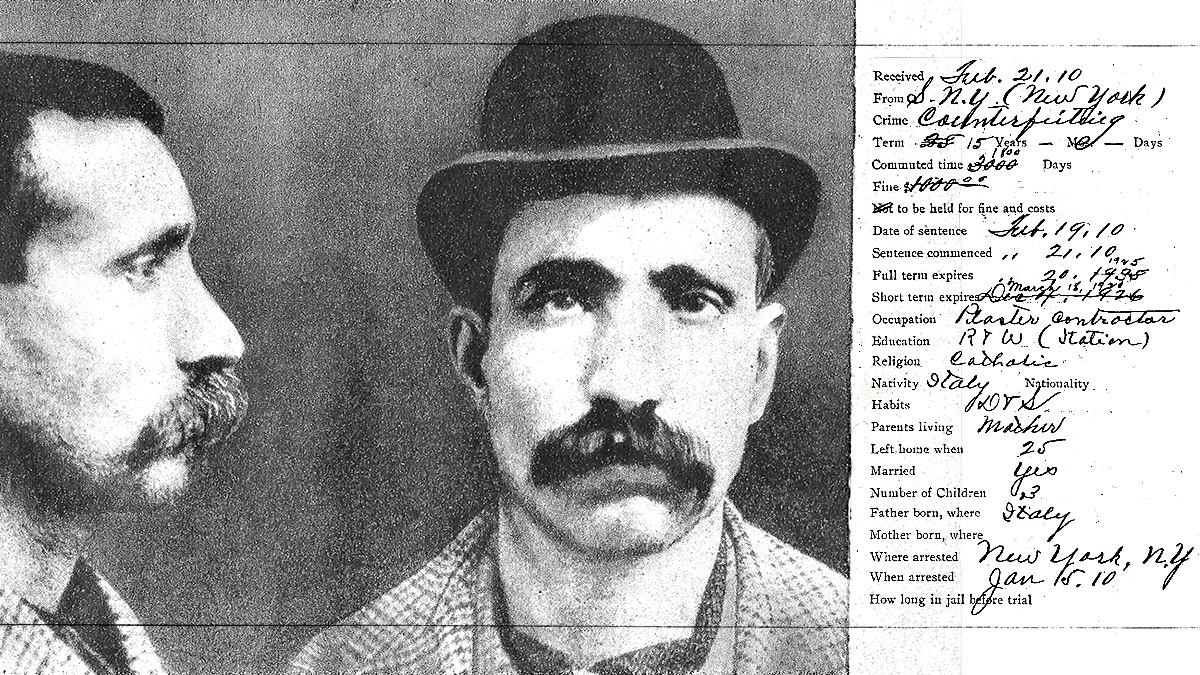
Giuseppe Morello
Giuseppe Morello was born at Corleone, Sicily, in May 1867. His entry into the local Mafia was likely facilitated by his stepfather Bernardo Terranova and uncle Giuseppe Battaglia, members of the Corleone borgata (a term meaning borough or village, within the Mafia it defines a clan or crime family).1
At the age of twenty-five, Morello left Sicily for America. His departure occurred around the time he was accused of killing a witness to a murder in Corleone.2 He arrived in New York in 1892, followed a year later by his family which included his half-brothers Nicola, Vincenzo and Ciro Terranova. After spending a year in New York, the family moved to Louisiana and then to Texas, before finally returning to New York around 1897.3
Morello first attracted the attention of the Secret Service in March 1899, after a letter he’d sent to a Boston counterfeiting gang was intercepted.4 He was suspected of distributing poor quality counterfeit notes and was arrested the following year on East 108th Street. Papers found in his possession connected him to Calogero Gulotta, whose son Gaspare was later involved the New Orleans Mafia. Morello was discharged after no direct connection could be made between him and the sale of counterfeit notes.5
In November 1900, Morello leased a saloon and basement at 445 13th St from Francesco Lo Curto6, who was later mixed up in a Black Hand conspiracy run by saloon keepers on the East Side.7 Morello gave up the business after just seven months. He later started a restaurant in the rear of the saloon at 8 Prince Street,8 a known hangout for counterfeiters and under regular surveillance of the Secret Service. The saloon was often mentioned in Secret Service reports. One agent stated, “more counterfeiters have been arrested at this address than any other place I know, it is one of the worst joints in the city.”9
It was often reported in sensational articles that Morello was the “Head of the Black Hand.” While he was found with letters connecting him to extortion of wealthy Italians, no arrests were made as a result.10 He repeatedly offered his services as a mediator between the Black Handers and their victims and was said to have “made much money settling the frightened of letters.”11 He acquired the gratis services of a family doctor after acting as his negotiator and was suspected of secretly extorting his own attorney, thinking his arbitration could lead to lower legal fees.12
His power was first indicated in July 1902, when he was reported to have “approved” the murder of Brooklyn Mafioso Giuseppe Catania. Catania liked to drink and “talked too much when drunk.” His mutilated corpse was eventually discovered dumped in Brooklyn in a similar fashion to the Barrel Murder.13

He incorporated a real estate co-operative in 1902, named the “The Ignatz Florio Co-Operative Association Among Corleonesi“, the company was involved in the construction and selling of properties in New York. Primarily a banking and real estate company, the company bought and sold multiple properties in New York before beginning construction of its own tenements in the Bronx. Shares in the company were sold to southern Italians with the expectation of dividends. The names listed on the incorporation as directors were Antonio Milone — a man who would later be involved with their counterfeiting schemes; Marco Macaluso, father of 1960s Lucchese Family “consigliere” (advisor) Mariano Macaluso; and Frank Badalato, who would later own the hay and grain store located next to infamous East 108th Street property known as the “Murder Stables”.14
Morello was arrested in April 1903, in connection with the New York Barrel Murder. The police discovered correspondence at his home at 218 Chrystie Street linking him to Santo Calamia and others in New Orleans. The Secret Service discovered that Italian counterfeiters in New Orleans had begun to sell their fake currency to bolster Morello’s defence fund. Following his release from the Barrell Murder trial, Morello was tracked in New Orleans with the Secret Service suspecting him of transporting counterfeit plates from New York.15

In 1906, Morello was suspected of being involved with the murder of Andrea Fondi, a Sicilian who had recently arrived in New York. The police charged Ignazio Milone with the murder, but the actual murderer was later reported to be Morello’s bother-in-law, Gioachino Lima.16
Morello’s Ignatz Florio Co-Operative, ran into serious financial problems around the time of the 1907 Bankers’ Panic. Anxious investors threatened to kill Morello, contractors and lenders started legal action against the business. In order to pay off his debts, Morello, along with Ignazio Lupo, started a counterfeiting plant in Highland, New York. The plan would eventually land them both in prison.17
He was released from Atlanta Penitentiary in 1920. Morello had lost close family to the gang feuds during his incarceration, including his half-brother Nicola and his son Calogero. Upon his release, he quickly eliminated Salvatore Loiacano, who had risen to lead the Morello Crime Family. Morello had disapproved of his handling of the clan, possibly due to Loiacono’s subordination to boss of bosses Toto D’Aquila. The killing sparked the beginning of a bitter three-year feud among the D’Aquila, Morello and Schiro Families.18
Morello, Lupo and other allies made a short trip to Palermo in late 1921.19 The reason for their voyage was later described in a confidential Secret Service report: 20
When Lupo and Morello were convicted fifteen or sixteen years ago on our counterfeiting case, new leaders arose. Since that time they have grown very strong and very popular. Upon the release of Lupo and Morello they tried to come back into power, but the new organization here in America would not permit this. Consequently, Lupo and Morello and a few of their old ‘standbys’ went to Sicily, taking it up there with the main headquarters endeavouring to be put back in power. They also refused … since that time Morello has moved to the West Side and both he and Lupo are living behind bars and shutters. Their assassination is expected momentarily.
Further detail was given in the memoirs of Mafioso Nicola Gentile. He explained that Lupo, Morello and ten others had been condemned to death by boss of bosses Salvatore D’Aquila at a meeting of the US Mafia’s General Assembly. “It was a question of power. D’Aquila was a very authoritative figure and that meant that those who didn’t support him were condemned to death.”21
Giuseppe Morello kept a low profile after his release from Atlanta Penitentiary. This was mostly due to the feud with D’Aquila. A consequence of Morello’s caution was a separation between his activities and the Secret Service’s network of spies. Although he was reported to be still active in counterfeiting22 the Secret Service did not connect him directly to any of their investigations. The warring families made temporary peace in August 1923 after a large conference at Highland, New York. It was agreed that Lupo would be brought back into the Fratellanza – but Morello was still to be excluded.23

Conflict between the Mafia Families flared-up again in 1928. Fifty-year-old Mafia leader D’Aquila was killed during a family visit to a doctor’s office in Manhattan. The assassination was ordered by Giuseppe Masseria, who replaced D’Aquila as the new boss of bosses, with Giuseppe Morello as his second in command. Masseria’s reign was brief. Both he and Morello were killed in the “Castellammarese War,” a violent struggle for control of the Mafia which began just two years later.24 Morello was killed in August 1930 in Harlem at East 116th Street, bringing the career of the first boss of the US Mafia to an end.25


- Warner, Santino, Van`t Riet. Early New York Mafia An Alternative Theory. The Informer. May 2014. Thomas Hunt. 42-43
Critchley, David (2009) The Origin of Organized Crime in America: The New York City Mafia, 1891–1931. New York: Routledge. 52[↩] - General Records of the Department of State, 1763 – 2002. Numerical Files, 1906 – 1910. M862 Roll 845. Giuseppe Morello criminal record.
Flynn, W. J. (1919) The Barrel Mystery. New York: The James A. McCann Company. 243-261[↩] - U.S. Circuit Court of Appeals for the Second Circuit, The United States of America vs. Guiseppe Calicchio et al, Transcript of Record. Ciro Terranova testimony[↩]
- U.S. National Archives and Records Administration (hereafter referred to as NARA), RG 87, Daily Reports of Agents, (hereafter referred to as DRA) William P. Hazen. Vol. 5 (Mar 18, 1899) [↩]
- NARA, RG 87, DRA. William P. Hazen. Vol. 9 (Jun 9, 12, 18, 28 1900)
Critchley. The Origin of Organized Crime in America. 58[↩] - Real estate record and builders’ guide. vol.66 (1900) New York: F. W. Dodge Corp. 589
Guiseppe Calicchio et al. 457[↩] - The New York Times. July 6 & 8 1908. [↩]
- Guiseppe Calicchio et al. Ciro Terranova testimony[↩]
- NARA, RG 87, DRA. William J. Flynn. Vol.6 (May 5, 1902) [↩]
- El Paso Times (Apr 18, 1903) [↩]
- NARA, RG 87, DRA. William Flynn. Vol. 29 (Feb 27, 1910) [↩]
- Critchley. The Origin of Organized Crime in America. 31-32
NARA. RG 87. DRA. William Flynn. Vol. 28 (Dec 13, 1909) [↩] - NARA, RG 87, DRA. William J. Flynn (Jan 4, 1903)
The Evening World (Jul 24, 1902) 1[↩] - The Ignatz Florio Co-Operative Association Among Corleonesi. Certificate of Incorporation. 1902
Critchley. The Origin of Organized Crime in America. 46[↩] - NARA, RG 87, DRA. Patrick Looby (New Orleans) Vol 9.
https://www.wikitree.com/wiki/Calamia-21 (Santo Calamia) [↩] - General Records of the Department of State, 1763 – 2002. Numerical Files, 1906 – 1910. M862 Roll 845. Giuseppe Morello criminal record.
The Yonkers Statesman. Jul 7 & 9, 1909.
https://www.wikitree.com/wiki/Lima-62 (Gioachino Lima)
Warner, Santino, Van`t Riet. Early New York Mafia An Alternative Theory. 45[↩] - NARA, RG 87, DRA. William J. Flynn. Vol. 28 (Nov 22, 1909)
Flynn. The Barrel Mystery. 30, 184
NARA, RG 87, DRA. William J. Flynn (Feb 10, 1913) Statement of Salvatore Cina
Central Union Gas Co. vs Browning (1911)
John A. Philbrick vs “Ignatz Florio Co-Operative Association Among Corleonesi”, et al. (1908) [↩] - Warner, Santino, Van`t Riet. Early New York Mafia An Alternative Theory. 63-64
“My ten biggest man hunts. William Flynn” Albuquerque Journal (Mar 13, 1922) [↩] - NARA, RG 87, DRA. New York. Vol. 76 (Dec 2, 1921) [↩]
- NARA, RG 87, DRA. New York. Vol. 80 (Oct 5, 1922) [↩]
- Critchley. The Origin of Organized Crime in America.. 155
Warner, Santino, Van`t Riet. Early New York Mafia An Alternative Theory. 64, 68[↩] - NARA, RG 87, DRA. New York. Vol. 83 (Mar 20, 1923) [↩]
- NARA, RG 87, DRA. New York. Vol. 85 (Aug 28, 30, 1923) & (Sep 21, 25, 1923) [↩]
- Warner, Santino, Van`t Riet. Early New York Mafia An Alternative Theory. 88-89
Critchley. The Origin of Organized Crime in America. 157, 181,185
Bonanno, Joseph, and Sergio Lalli. A Man of Honour: the Autobiography of a Godfather. Deutsch, 1983. 100 (morello 2nd in command) [↩] - New York Times (Aug 16, 1930) & (Apr 16, 1931) 1[↩]